

AI project management jobs are showing up on job boards. Here is what that means for your role
You may have seen AI project management jobs posted on Jobstreet, Indeed, or LinkedIn. You may wonder if you need a new title to stay employable. The short answer: probably not yet. But the skills behind that title are worth building anyway, no matter what your current job title says.
The job title exists. It was being posted at the time of this research, across Malaysia, Singapore, and Australia. The exact number of live listings was not recorded and can change by the time you read this. In most postings, the role is not a full replacement for the project manager role you already hold. It is closer to an existing PM job with AI-specific duties added on top.
This article does not compare project management software or tell you to buy anything. It looks at what the role involves, what it pays where data exists, and what skills transfer, whether or not you ever apply for a job with "AI" in the title.
What AI project management jobs actually involve
Live job board listings describe a role close to standard technical project management, with AI delivery work added to the scope. A Jobstreet Malaysia listing for the title describes consulting clients on AI solutions and coordinating AI projects, from requirements and prototyping through to final delivery. That is project management language with an AI subject attached. It is not a different discipline.
A guide from em-lyon.com, written for students and career changers, defines an AI project manager as someone who "leads AI projects from strategy to deployment, ensuring performance, governance, compliance, and measurable business" results.
A small sample of listings on builtin.com, three postings reviewed for this article, shows a similar shape. The job asks for cross-functional coordination between product, engineering, data, and business teams. AI is the subject of the work, not a new management method. That is too small a sample to call an industry pattern. But it matches the other listings reviewed here. The job still asks for the same core PM skills: scoping, scheduling, stakeholder communication, and risk tracking.
How it differs from a standard PM role
The real difference is subject-matter depth, not a new skill category. You still run intake, prioritization, and status reporting. The difference: the backlog now includes model evaluation, data governance questions, and vendor or platform dependencies that a traditional software PM might not face as often.
What employers are actually asking for
Across the listings reviewed, employers ask for experience delivering AI or data-enabled projects, cross-functional coordination skills, and familiarity with tools the team already uses, such as Jira or Linear. None of the listings reviewed listed a formal AI PM certification as a hard requirement.
Is AI replacing the PM role, or changing it?
Practitioners debate this. A Reddit thread in r/projectmanagers includes the view that "AI application in all industries and contexts must be human led," with PM roles staying important because someone has to apply judgment to what AI produces. That is one community's view, not a measured industry trend. But it reflects a reasonable point: the tools change, but the need for a person who checks and decides does not go away.
Consider an illustrative delivery lead at a mid-sized agency. Her team started using an AI tool to draft weekly status summaries from project chat threads. The drafts save her time. But she still reads each one before sending it to a client, because the tool sometimes pulls in a comment that was later retracted, or misreads which deliverable a message referred to. The time saved shows up in drafting, not in removing her from the review step.
Where AI tools assist today
One example of this pattern: Jensi can pull a candidate task out of a Slack conversation and present it for review, instead of leaving it buried in the thread. A person still checks the source message before accepting the suggestion as tracked work. Our guide on turning Slack messages into tasks without losing context covers this pattern in more detail.
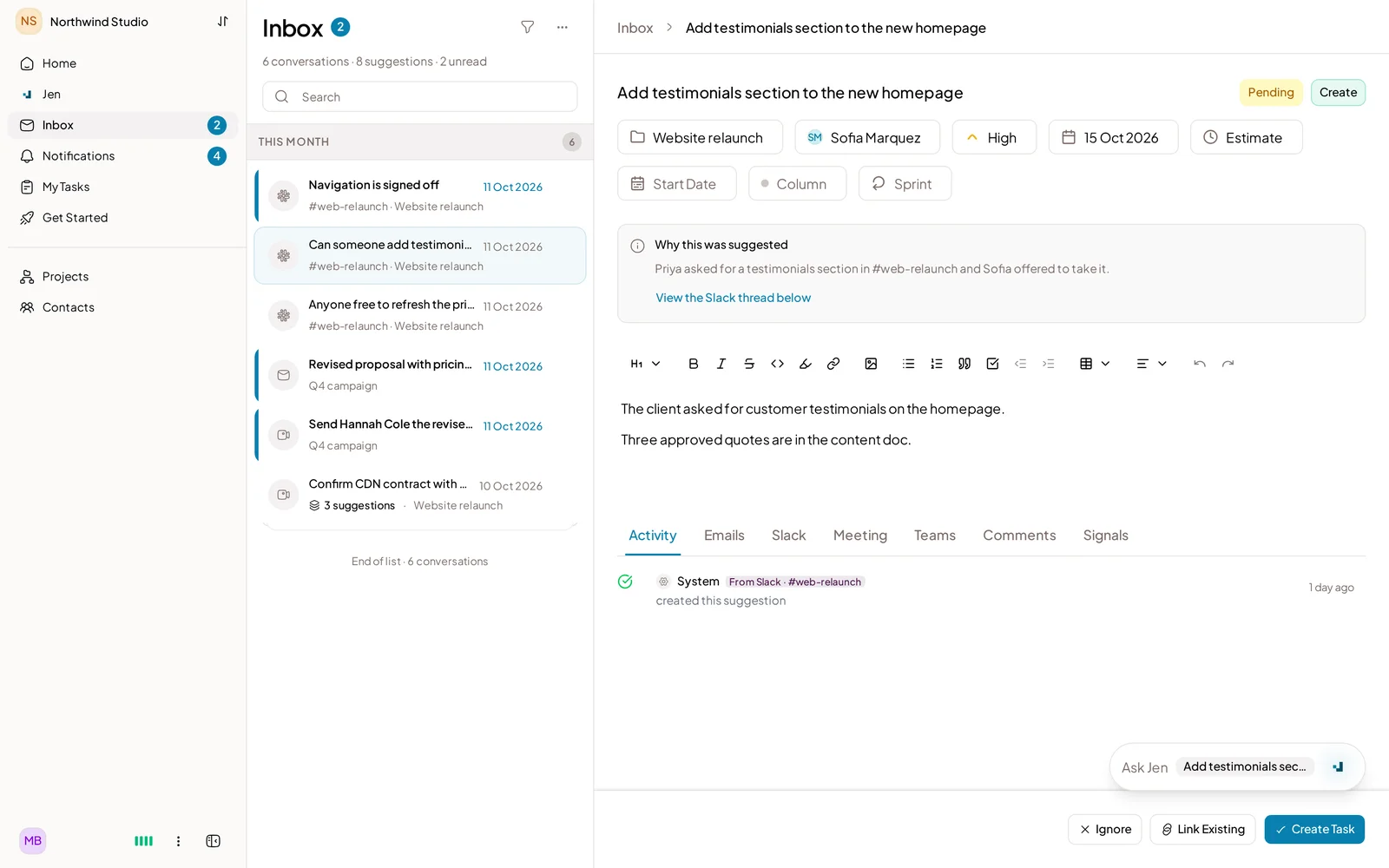
A task suggestion pulled from a Slack thread
Where human review still matters
Some things still need a human judgment call: whether a surfaced item is really a commitment, who owns it, and whether it belongs on this sprint's board. Before AI-suggested work becomes a tracked task, someone needs to check the source message or meeting note it came from. That review step is where the job still looks like project management, no matter what the AI did upstream.
AI project management salary: what the data shows, and what it does not
Here the research runs into a real limit. It is worth being direct about that instead of guessing.
What is confirmed
Two US-market sources give concrete figures. According to ppm.express, citing Glassdoor data, the average AI manager salary in the United States is about $115,095 per year. That rises to roughly $165,711 with bonuses. Separately, builtin.com lists senior-level AI project management roles posted in the $116,000 to $175,000 range, also US market, drawn from live job listings rather than a survey.
Both figures describe US pay at one point in time. They are not a reliable stand-in for pay in Malaysia or the wider APAC region, where cost of living, hiring markets, and typical PM pay differ a lot.
What is not confirmed for Malaysia or APAC
No Malaysia-specific salary survey turned up in this research. Job board listings on Jobstreet, Indeed Malaysia, and SEEK Australia confirm that the job title is actively posted in the region right now. They do not tell you typical pay, how many roles exist, or whether postings are growing or shrinking over time. If you need a Malaysia or APAC salary figure, check a regional salary guide from a recruiter such as Hays, Robert Walters, or Michael Page, or JobStreet's own salary report, before relying on a number here.
How to build AI-relevant PM skills without chasing a title change
You do not need to wait for a title change to start building the parts of this work that transfer. The skills employers list in AI PM postings, triage, cross-functional coordination, and governance awareness, are mostly extensions of what a strong PM already does. If you want to try AI project management free, before paying for anything, many tools in this space offer a free tier or trial. That is a reasonable way to test whether the review habits below fit how you work.
A few skills that transfer directly:
- Triage discipline. Practice sorting incoming requests by source and urgency before they land on a board, instead of accepting everything as a ticket.
- Source-context habits. When a task starts in a chat thread, meeting, or email, keep the original message attached. Anyone reviewing it later can check what was actually said.
- Review-before-accept routines. Treat any AI-suggested task the same way you would treat a verbal request from a stakeholder: confirm it, then track it.
Our guide on keeping a decision log from meetings and email is a practical way to build the second habit. Our page on work intake for delivery teams covers reviewing requests before they become tickets, which is close to the daily reality of either a standard PM role or an AI-titled one.
Should you pursue an "AI project manager" title?
A title change makes more sense if you are already doing AI-adjacent delivery work and want your resume and pay to reflect it. It also makes sense if you are early in your career and want a focused way into AI-heavy teams. It makes less sense as a defensive move against job insecurity. The research here does not support a claim that standard PM roles are being replaced by this title. The listings suggest an expansion of scope within project management, not a separate career ladder that makes the existing one obsolete.
If you are unsure, build the skills in place instead: triage, review discipline, and comfort evaluating AI-suggested work. That gives you most of the practical benefit without betting your resume on a job category that is still too new to have reliable regional salary data.
Limitations
This article does not state a Malaysia or APAC AI project manager salary figure, because no regional salary survey was found during research. Treat the US figures cited here as a reference point only, not a Malaysia benchmark. The job board listings confirm that the title is posted in the region today. They do not establish hiring volume, growth rate, or trend over time, and none of that is claimed here. Before you use any specific pay number for this market, check a current regional salary guide directly.
Where Jensi fits
Jensi helps with the review habit this article describes, not with job hunting or salary benchmarking. It captures candidate work surfaced from Slack and other connected conversations, and a person reviews each suggestion before it becomes tracked work. If you want to practice that review routine in your current role, you can sign up for Jensi.